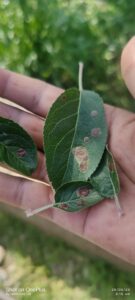

A Deep Dive into the Spider Mite Crisis in Kashmir’s Apple Orchards
If you walk through the sprawling apple orchards of Kashmir in late spring, the air is thick with the sweet smell of blossoms and the promise of a prosperous harvest. For generations, these orchards have not just been the pride of the valley they are its economic lifeblood, sustaining thousands of families. But if you sit down and talk to the farmers in Shopian or Anantnag today, the conversation quickly shifts from the beauty of the bloom to a quiet, creeping dread.
Over the last decade, a microscopic, nearly invisible enemy has laid siege to the valley the spider mite. What started as isolated whispers of rusted leaves has exploded into full blown orchard flareups, turning lush, green canopies into withered, bronzed husks in a matter of days.
As someone who closely follows agricultural shifts and spends time speaking with both cultivators and entomologists, watching this crisis unfold over the past ten years has been a masterclass in how fragile our agricultural ecosystems truly are. Here is an elaborated, detailed look at how this pest took hold, the exact science behind the flareups, and the comprehensive strategies our farmers are using to fight back.
The Genesis: How the Last Decade Changed Everything
While various species of mites have always existed in the Himalayan ecosystem, they were historically kept in check by natural predators and the region’s cooler climate. However, the last ten years have seen a perfect storm of changing agricultural practices and shifting weather patterns.
The first major alarms were raised in the premium apple producing villages of South Kashmir’s Shopian district specifically in areas like zainapora belt, Babapora, Awneera, Pahnoo and two hamlets of bijbehara semthan and Dupatyar reported a novel pest spinning protective silk webs and suffocating trees.
What triggered this sudden explosion?
The answer lies largely in modernization. To increase yield, Kashmir heavily adopted High-Density (HD) apple orchards over the last decade, importing specialized rootstocks from Europe. A pivotal 2021 study by Mr. Sheikh Khursheed, ZA Bhat, GH Rather, H Itoo, AR Malik and Bilal A Pandit https://www.entomoljournal.com/archives/?year=2021&vol=9&issue=1&ArticleId=8274 which examined highdensity apple ecosystems in Shopian, revealed that these new setups fundamentally changed the orchard microclimate. The trees in HD orchards are planted much closer together, altering airflow, light penetration, and humidity. This new microclimate, combined with instances where imported plant materials bypassed rigorous quarantine (bringing foreign mite strains with them), created an absolute paradise for these pests.
The Pyrethroid Paradox
For generations, spider mites existed in Kashmir’s orchards without causing mass destruction. They were kept in check by a microscopic standing army of natural predators:
- Predatory Mites (like Phytoseiidae species) that actively hunt and consume spider mite eggs and adults.
- Ladybird Beetles (Stethorus punctillum), specifically nicknamed the mite destroyer.
- Minute Pirate Bugs and Lacewings, which feast on various soft-bodied pests.
When orchardists began heavily spraying pyrethroids, it completely wiped out this predatory army. Natural enemies are highly sensitive to these chemicals and take a long time to repopulate because their breeding cycles are relatively slow.
While the predators died off, the spider mites did not. In fact, they thrived. This happens for two devastating reasons:
- Rapid Resistance: Spider mites have an incredibly fast life cycle going from egg to reproducing adult in just a week during hot weather. This rapid turnover allows them to develop genetic resistance to insecticides much faster than their predators can. The pyrethroids quickly stopped killing the mites altogether.
- Hormoligosis (Reproductive Stimulation): Entomologists have documented a bizarre and destructive phenomenon where exposure to sub lethal doses of pyrethroids actually stimulates spider mites. The chemical stress triggers their nervous systems to go into overdrive, causing females to lay significantly more eggs than they would in an untreated orchard.
Identifying the Invaders
When we talk about the mite flare, we are actually dealing with a multi-front war involving specific, highly aggressive species:
- The Two-Spotted Spider Mite (Tetranychus urticae): This is the most notorious offender. Females are tiny, oval-shaped, and identifiable by two distinct dark spots on their backs. They overwinter as adults in the orchard ground cover and weeds, migrating up into the apple trees as the summer heat sets in.
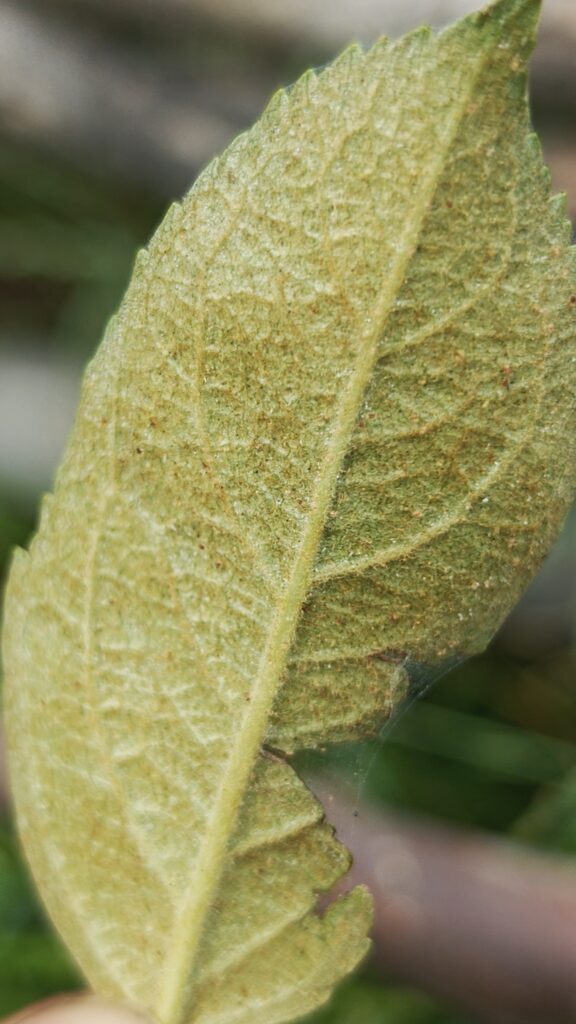
- The European Red Mite (Panonychus ulmi): Unlike the Two-Spotted mite, the ERM overwinters directly on the apple tree as tiny, globular red eggs hidden in the crevices of the rough bark. Once they hatch, they immediately begin attacking the new spring foliage.
Both species feed by inserting microscopic, needle like mouthparts into the plant tissue, sucking out the cellular fluids and chlorophyll.

What the Research Papers Tell Us
The anecdotal panic of the farmers is heavily backed by recent, rigorous scientific literature emerging from local agricultural universities like SKUAST-Kashmir.
The Climate Connection:
A highly detailed 2026 research paper https://journalacri.com/index.php/ACRI/article/view/1777 published in the Archives of Current Research International, meticulously tracked the seasonal incidence of the Two Spotted Spider Mite in Kashmir. The researchers found a mathematically significant positive correlation between rising temperatures and mite population explosions. The data mapped out that while populations are manageable in the spring, they hit their absolute peak during the 27th and 28th Standard Meteorological Weeks (mid-July), exactly when the valley experiences its hottest, driest spells.
The Ecological Imbalance:
The 2021 study https://www.entomoljournal.com/archives/?year=2021&vol=9&issue=1&ArticleId=8274 highlighted another critical issue: the destruction of natural enemies. In the rush to control early pests like aphids, farmers often over-applied broad-spectrum chemical insecticides. This indiscriminately wiped out natural predators like the ladybird beetle (Stethorus aptus) and predatory mites (Amblyseius fallacis). Without these natural police in the orchards, spider mite populations which reproduce at astonishing rates experienced unchecked, exponential growth.
The Anatomy of a Flare Up and Crop Damage
A mite flare doesn’t just damage the leaves it fundamentally breaks the tree’s ability to feed itself.
Agronomists measure mite damage in Cumulative Mite Days (CMDs). When populations spike, the initial damage appears as light stippling or speckling on the leaves. Within a week, as the mites multiply into the thousands per leaf, this progresses to severe bronzing the leaves literally turn a rusty, burnt brown because they have been drained of all chlorophyll.
Without chlorophyll, photosynthesis stops. The immediate result is smaller, poorly colored fruit that drops prematurely. The long-term devastation is worse, a severely bronzed tree fails to store enough carbohydrates for the winter, leading to drastically reduced fruit set and poor bloom in the following year.
The Battle Plan: Comprehensive Mitigation Measures
The days of simply spraying the hardest chemical available are over mites build genetic resistance to pesticides faster than almost any other agricultural pest. Today, saving Kashmir’s apples requires a highly strategic Integrated Pest Management (IPM) approach:
1. The Winter Offensive (Dormant Sprays)
Because the European Red Mite overwinters as eggs on the tree bark, the most critical mitigation step happens before the trees even have leaves. Farmers are now trained to apply Horticultural Mineral Oils (HMOs) during the dormant season (late winter/early spring). These heavy oils coat the branches and literally suffocate the overwintering mite eggs, preventing the first generation from ever hatching. Studies show that a 2% to 2.5% concentration spray of HMOs can achieve up to 80% mortality of these eggs.

2. Targeted Chemical Interventions (Acaricides)
When summer heatwaves trigger a Two-Spotted Spider Mite flare, precision chemistry is required. Broad-spectrum insecticides actually make the problem worse. Instead, farmers must use specific acaricides. The 2026 study https://journalacri.com/index.php/ACRI/article/view/1777 confirmed that molecules like Fenazaquin (10% EC) and Abamectin (1.9% EC) are currently the most highly effective treatments in the Kashmir climate. However, these must be rotated strictly to prevent the mites from developing resistance. Simodis Insecticide by Syngenta (Isocycloseram 9.2% w/w DC + Isocycloseram 10% w/v DC)

and Acequinocyl 15% w/v SC (Kanemite mahindra)

are highly effective against all stages of two spotted spider mites and red mites.
3. Biological and Botanical Warfare
The most sustainable long term fix is reintroducing nature’s balance.
- Entomopathogens: Researchers are heavily promoting the use of bio-control agents like the fungus Lecanicillium lecanii, which naturally infects and kills mites without harming the environment.
- Botanicals: Neem based extracts like Nimbecidine act as powerful natural repellents and growth disruptors for mites.
- Predator Conservation: Farmers are being educated to foster habitats for natural predatory mites (like Phytoseiidae species), which actively hunt and eat spider mites.
4. Cultural and Mechanical Practices
Spider mites thrive in hot, dry, and incredibly dusty environments.
- Dust Control: Driving tractors too fast on dirt orchard roads kicks up dust that coats the leaves, creating a perfect micro habitat for mites. Watering down paths is a simple but highly effective mitigation tactic.
- Irrigation: Drought-stressed trees pump more sugars into their sap, which is like setting out a buffet for mites. Maintaining proper soil moisture through drip irrigation especially in HD orchards keeps the tree’s natural defenses high.
- Weed Management: Since Two Spotted mites overwinter in broadleaf weeds on the orchard floor, clearing the base of the trees before spring forces the mites out of their hiding spots.
Looking Forward
The spider mite flare in Kashmir is a harsh reminder of how delicate the balance of modern agriculture is. The combination of imported high-density farming, changing climates, and pesticide misuse created a decade of hardship for orchardists. But there is a distinct sense of hope now. Armed with hyper local research, strict rootstock quarantines, and a shift toward Integrated Pest Management, the farmers of the valley are learning not just to fight the mites, but to outsmart them. The battle is far from over, but the orchards are fighting back.
Spider mite threatens apple crop in Shopian village
This local news report from Shopian provides a ground level view of the devastating impact spider mites are having directly on Kashmir’s apple farmers.
Conclusion
The last ten years have tested the resilience of Kashmir’s orchardists like never before. The sudden and devastating spider mite flare ups are a harsh wake up call, exposing the vulnerabilities that come with shifting climates, changing micro ecosystems, and unchecked modernization. But as the latest research and on the ground mitigation efforts clearly show, this is no longer an unwinnable war.
We now understand the enemy. The transition from indiscriminate chemical spraying to a targeted, Integrated Pest Management (IPM) strategy marks a major turning point for the valley. By treating the orchard as a living, breathing ecosystem where dormant winter oils, precise summer acaricides, and natural predators work in harmony farmers are actively reclaiming their livelihoods.
Protecting the agricultural heartbeat of Kashmir requires continued vigilance. It means demanding stricter quarantine protocols for imported rootstocks, staying adapted to the changing climate, and sharing successful strategies across the farming community. The spider mite might have caught the valley off guard a decade ago, but armed with localized science and sustainable practices, Kashmir’s apple industry is well-equipped to ensure its orchards keep thriving for generations to come.